

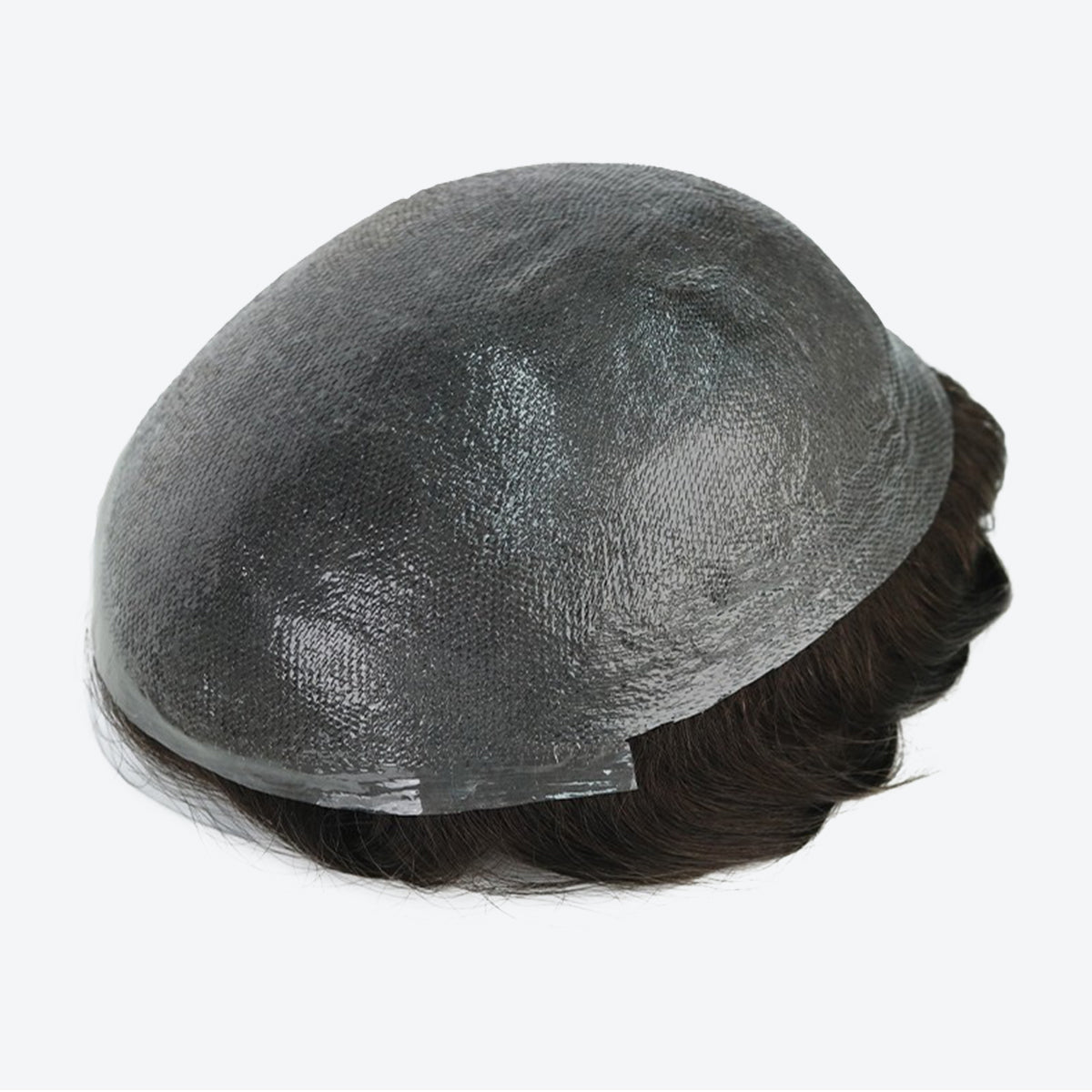
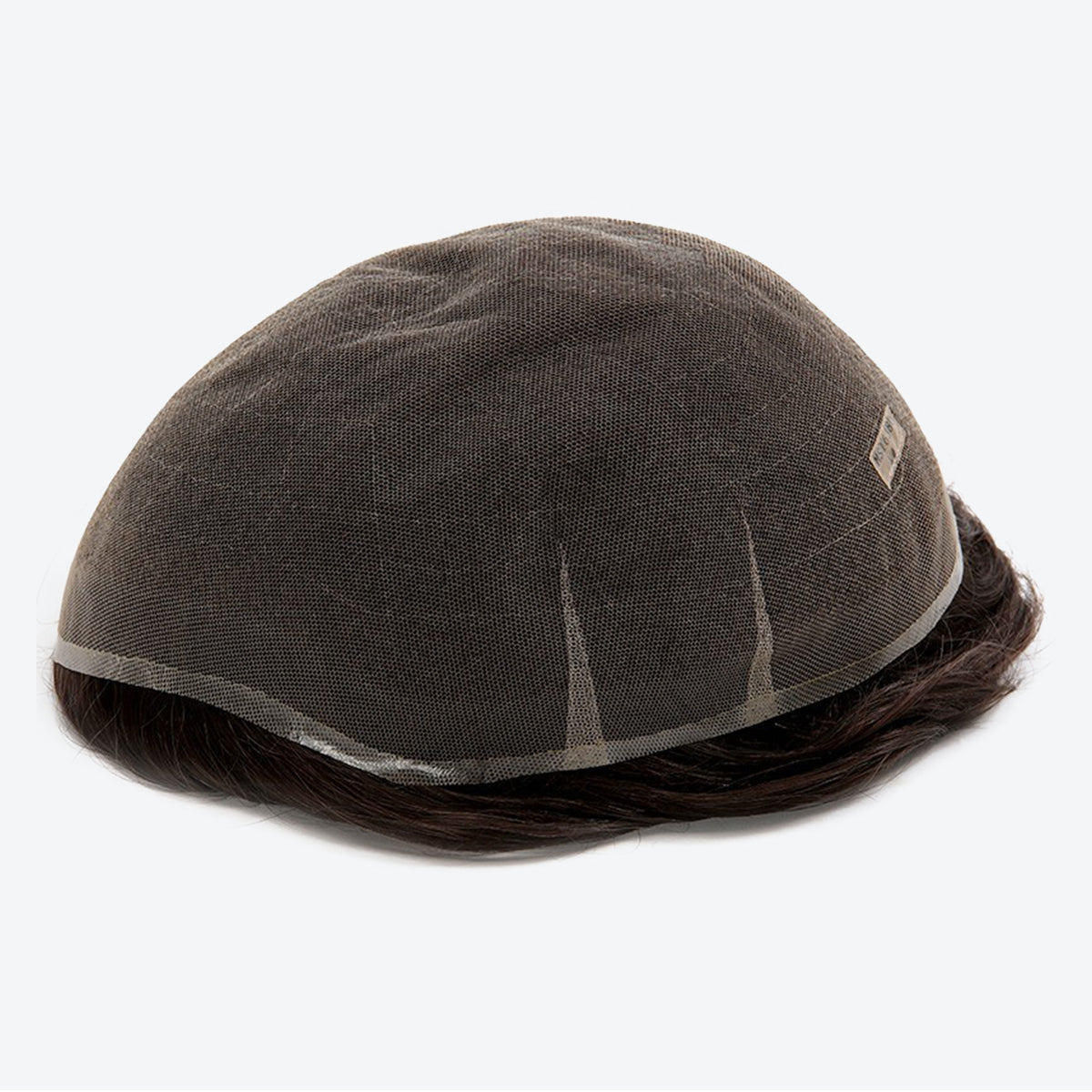
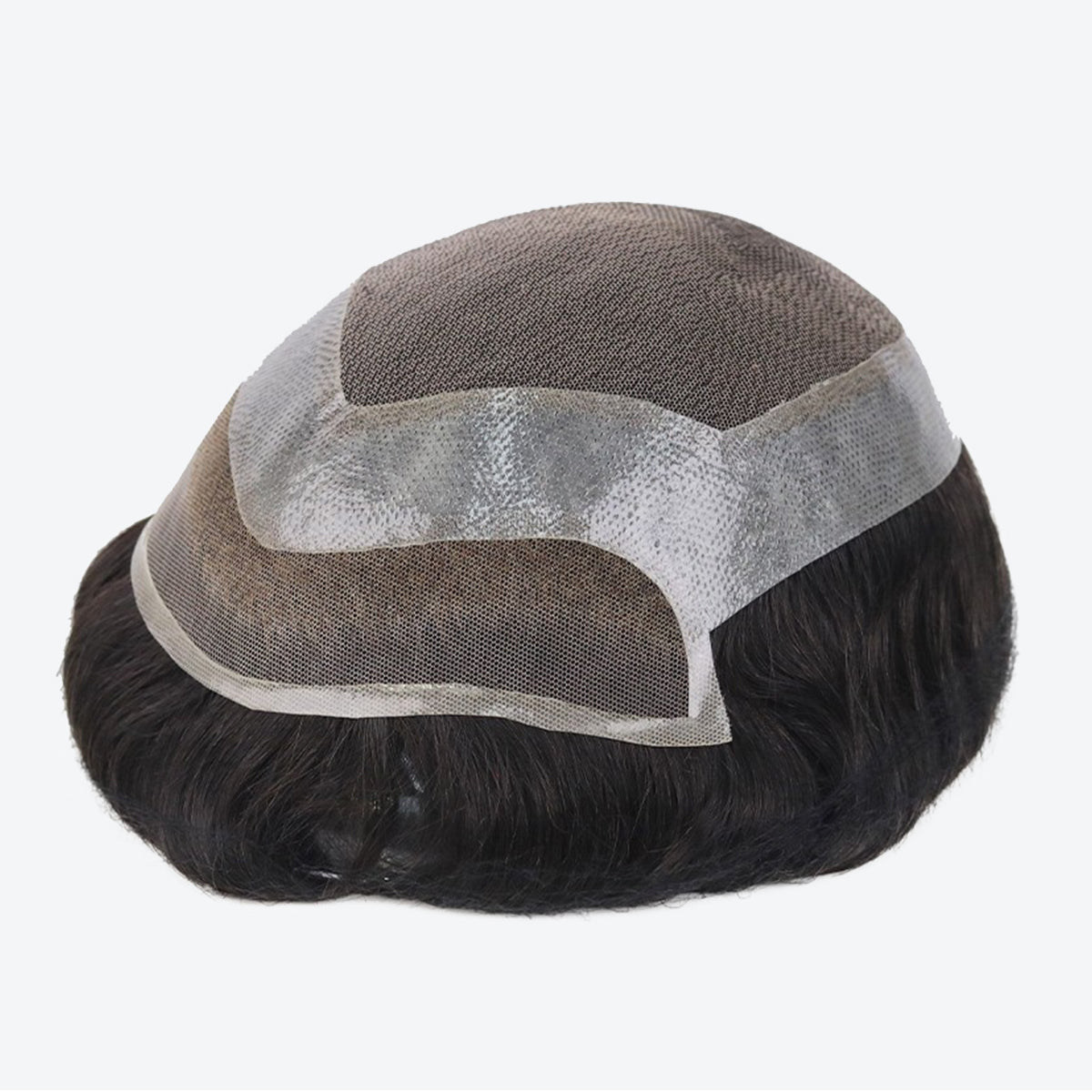

V-loop is easy to misread in a product specification. It is not another name for thin skin and it is not a quality grade; it tells you how hair is placed into a skin or polyurethane base without a tied knot at the loop point. The next details matter just as much: whether V-loop covers the full base or only the front, what secures the hair in the other zones, and how much handling the base thickness can tolerate.
Two products can therefore both say V-loop and still suit different wearers. Some older product pages and search results use the phrase V-loop toupee; here, it means a V-loop hair system, not a separate product category. This guide shows how to read that specification before comparing appearance, styling, attachment, and maintenance.

Quick Answer
A V-loop hair system uses folded strands set into a thin polyurethane base so there is no tied knot at each loop point. Full V-loop construction may fit someone who puts front and parting presentation ahead of a longer replacement cycle and is comfortable handling a delicate skin base. A V-loop front combined with more secure ventilation elsewhere may suit a wearer who wants a softer visible front with more support through the top and back. Neither direction is automatically best. Compare the base thickness, V-loop coverage area, density, hairstyle, attachment method, removal routine, and current product specifications together.
Quick Takeaways
- V-loop is a ventilation technique, not a fifth base type.
- It is most often used with thin or ultra-thin skin/poly because a knot would be more visible through the film.
- Full V-loop and V-loop-front systems solve different priorities.
- No visible knot does not guarantee an invisible result; placement, density, cut-in, and the front edge still matter.
- A thin skin base needs a compatible liquid-glue and removal plan before the first wear.
If you are not sure, use two default paths
Intentional scope: this article explains V-loop selection. It does not decide swimming, travel, sensitive-scalp, or high-sweat attachment protocols; check the dedicated guide for the scenario that applies after choosing a construction direction.
Path A - V-loop skin route: Start with a V-loop front or full V-loop skin system only when the clean surface is worth the lower airflow and more careful liquid-glue removal routine.
Path B - airflow-first route: If warmth and airflow matter more than a knotless skin surface, compare a lace or breathable hybrid direction instead. Lace wears compatible tape as its first-wear route; skin/poly wears compatible liquid glue.
Your first attempt does not need to solve every future wearing situation. Choose at your own pace and reassess the trade-off over time. This article will not choose an adhesive brand, guarantee a hold time, or decide medical suitability.
What does V-loop mean in a hair system?
In V-loop ventilation, a strand is folded and inserted into a polyurethane base so the two ends emerge from the surface. From the side, the strand forms a shape similar to a V inside the base. Because the hair is not tied into a conventional knot at that point, the base can show a cleaner surface around the strand.
That description explains the technique, not the whole system. Two products can both say V-loop while using different skin thicknesses, densities, loop coverage areas, front shapes, or reinforcement methods. Those differences affect how the unit looks, feels, sheds, handles removal, and fits a daily routine.
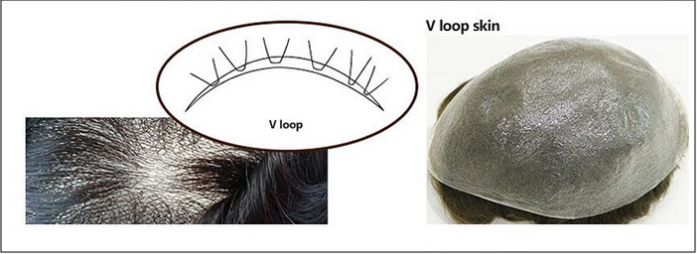
How is V-loop different from knotted ventilation?
The difference is not simply natural versus durable. Ventilation methods give the hair and base different jobs, and a system may use more than one method by zone.
| Construction direction | What it may help with | Trade-off to understand | Questions to ask |
|---|---|---|---|
| Full V-loop on thin skin | A clean surface through the front and parting areas; lighter-density presentation | Looped hair and a very thin base can be less forgiving of pulling, aggressive cleaning, or rough removal | How thin is the base? What density is used? Am I comfortable with a shorter replacement cycle? |
| V-loop front with secure ventilation elsewhere | A clean visible front while giving top/back hair more anchoring | The system is not knotless everywhere, and the front remains the delicate visual zone | How wide is the V-loop front? What method is used behind it? Which zone will need the most care? |
| Knotted hair on a compatible base zone | Stronger anchoring for density, handling, or less-visible areas | Knots may be more noticeable through a very fine or highly exposed zone | Is the knotted area visible in my hairstyle? Does its structure solve a real need? |
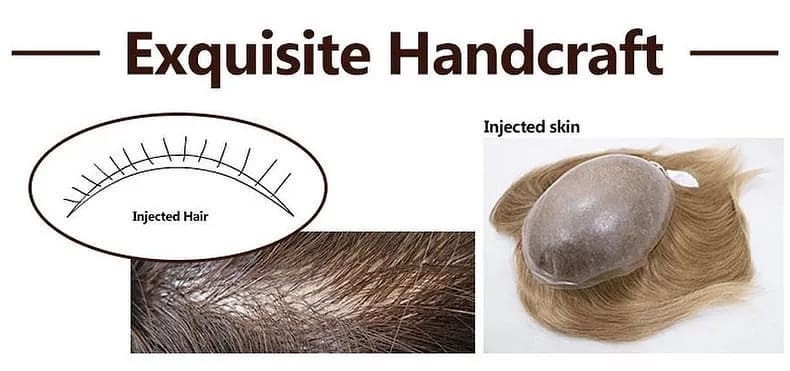
| Injection or another knotless technique | A different direction of hair placement and surface appearance | Technique names are not interchangeable; movement, density, and base construction can differ | What exact method is used, and where? What does the current PDP specify? |
V-loop can be the right tool for a visible zone without needing to cover every part of the base.
How does V-loop compare with flat injection, lift injection, and single-split knots?
Older articles sometimes use V-loop and injection as if they were interchangeable. They are better treated as separate ventilation directions. The exact manufacturing method and compatible base specification remain product-specific.
| Technique | Basic construction | Where it may help | Trade-off or question to check |
|---|---|---|---|
| V-loop | A strand folds into and returns through a skin/poly layer without a tied knot at the loop point | A clean-looking visible front or parting area; full-base or selected-zone use | Confirm the coverage area, density, base thickness, and handling tolerance. V-loop does not make solid skin breathable. |
| Flat injection | Hair is inserted into a skin/poly base and set to lie in a more defined direction | Shorter or controlled styles where a planned lay is useful | Direction may be less flexible after construction. Verify the intended hairstyle and current product specification. |
| Lift injection | Hair is inserted and constructed to retain more root lift | Styles that need more lift or movement from the base | Root lift is not a guarantee of durability or a universally natural result; base construction and handling still matter. |
| Single-split knots | Hair is tied for anchoring in a compatible zone | Top, back, or less-visible zones that need more support than a very fine looped area | Knot visibility depends on the base, density, processing, and hairstyle. Check whether the knotted zone will be exposed. |
This comparison does not turn the V-loop article into a universal ventilation guide. Single and double knot variants used across lace, mono, and other base zones remain a broader topic and should not be redirected here solely because they mention V-loop.
Should you choose full V-loop or a V-loop front?
Start with the area people will actually see. If you wear the hair brushed back or part it through a wide area, the front and parting presentation may deserve more weight. If the hairstyle covers most of the front, using the most delicate construction everywhere may add handling sensitivity without solving a visible problem.
| Your priority | Direction to compare | Reality check |
|---|---|---|
| Clean front and parting presentation across a wide area | Full V-loop on a compatible thin skin base | Accept that the fine base and looped hair need patient attachment, removal, and cleaning. |
| Exposed front with more support through the top/back | V-loop front plus more secure ventilation elsewhere | Confirm the width of the V-loop zone and how the transition is handled. |
| Covered or semi-covered front with repeatable home maintenance | A less extreme skin construction may be easier to learn | Do not pay a handling cost for an invisible zone your hairstyle does not expose. |
| Fuller density or frequent styling | Secure ventilation in less-visible zones may matter more | Density, anchoring, and the front design should be chosen together. |
| Maximum airflow | Compare lace or a breathable hybrid instead of relying on V-loop | V-loop does not make a solid skin base porous. |
How do current LaVivid V-loop configurations differ?
LaVivid uses V-loop in more than one way. In our experience, the product name alone is less useful than checking where V-loop is used and what supports the remaining zones. These examples are not a ranking; they show why the coverage area matters.
Full V-loop direction: Upgrade Eros
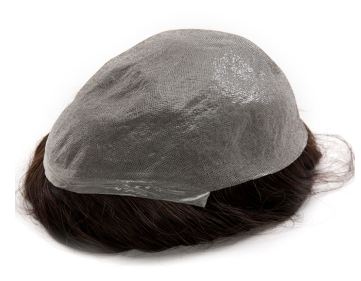
Upgrade Eros currently uses a 0.02-0.03 mm bio-skin base with fully knotless V-loop construction. This direction may fit a wearer who prioritizes a very fine base and visible-front presentation and who accepts a more delicate handling routine and shorter replacement-cycle direction. It may be a poor fit when maximum airflow, heavy daily activity, or a longer replacement cycle matters more.
Zone-optimized direction: Upgrade Mirage
Upgrade Mirage currently uses a 0.04-0.06 mm skin base with a V-looped front and single split knots through other areas. The front addresses the visible transition while the other zones give the hair more anchoring. This may fit someone who wants a visible-front option without choosing full V-loop across the entire base. It remains a solid skin system, so airflow is still limited compared with lace.
Product specifications can change. Check the current PDP before ordering rather than relying on an older review, screenshot, or model description.
What can V-loop improve, and what can it not solve?
V-loop may reduce the visibility of tied knots at the point where hair enters a thin skin base. It can also support a lighter-density presentation and flexible hair movement when the product is built and styled for that purpose.
It cannot solve every factor that makes a system look natural. A front edge can still be visible if placement, adhesive, density, color, cut-in, or the condition of the base is wrong for the wearer. A full skin base can still feel warm because V-loop does not add airflow holes. A knotless surface also does not make the hair immune to shedding or the base immune to tearing.
| What you want | V-loop may help | What still decides the result |
|---|---|---|
| A softer visible front | Removes a tied knot at the loop point | Base edge, placement, density, adhesive, and cut-in |
| A natural-looking part | Keeps the surface around each loop visually clean | Part width, density, color, direction, and lighting |
| Flexible styling | Can allow movement from the loop point | Ventilation direction, hair length, density, and stylist work |
| Easy maintenance | A smooth skin surface can make residue easier to see | Compatible adhesive, remover, removal speed, and base thickness |
| Better comfort in heat | V-loop itself does not provide airflow | Solid coverage area, climate, activity, and base material |
How should you attach and remove a thin skin V-loop system?
For a thin or ultra-thin skin/poly system, LaVivid's beginner route is compatible liquid glue applied in thin layers to the scalp according to the product directions. Tape is not the starting recommendation for a skin-base beginner because peeling tape from a fine polyurethane film can put concentrated stress on the base.
Before the first full wear:
- Confirm that the adhesive is compatible with the current product and your intended wear routine.
- Use a separate patch-test day and follow the product's waiting period, often 24-48 hours when the label directs. The first-wear day is a later session, not part of the patch test.
- Have the matching remover ready; do not plan to improvise removal after the bond is already in place.
- Release the bond gradually. Do not pull the system away while resistance remains.
- Stop if the base begins to stretch or tear, or if the scalp has persistent redness or broken skin.
Attachment performance varies with scalp preparation, environment, activity, adhesive, application, and cleaning routine. A V-loop label does not determine hold time.
How can you reduce avoidable shedding and base damage?
The goal is not to make a delicate system permanent. It is to avoid adding unnecessary stress.
- Remove the bond fully before lifting the base.
- Support the base close to the area being cleaned instead of pulling from a distant edge.
- Follow the current adhesive and remover directions rather than scrubbing residue aggressively.
- Detangle hair gently before washing and avoid pulling at the root area.
- Record where shedding or stretching begins. A repeated problem in one zone may point to attachment, removal, styling, or construction fit rather than a universal material failure.
- Recheck the PDP and support guidance when a product construction changes.
What should you check before buying a V-loop hair system online?
Do not stop at the word V-loop. A useful product page should make the full configuration clear.
| Specification | Why it matters |
|---|---|
| Base material and thickness | Shows whether the system is ultra-thin, super-thin, or a stronger skin direction and indicates how careful handling needs to be. |
| V-loop coverage area | Distinguishes full-base V-loop from a V-loop front or another selected zone. |
| Ventilation outside the V-loop zone | Explains how hair is secured through the top, back, or perimeter. |
| Density and hair direction | Helps you judge whether the result can blend with your side/back hair and preferred style. |
| Front shape and hairstyle | Shows whether the construction supports an exposed, semi-covered, or covered front. |
| Attachment and removal guidance | Confirms the routine required before the first wear. |
| Best fit and not-best fit | A credible page should acknowledge who may need more airflow, strength, or handling tolerance. |
| Current stock, support, and return terms | Prevents an old article or cached product description from becoming the purchase decision. |
If a product page does not make those details clear, take your time and ask before ordering; there is no need to choose from the word V-loop alone. When the construction is clear, compare current skin hair systems by configuration rather than treating V-loop as a quality score.
FAQ
Is V-loop a type of hair system base?
No. V-loop is a hair-ventilation method used in compatible skin or polyurethane bases. The base material, thickness, density, front design, and other ventilation zones still need to be specified separately.
Does a V-loop hair system have knots?
There is no tied knot at each V-loop point. However, a system described as V-loop may use knots or another ventilation method outside the V-loop zone. Check whether the product is full V-loop or V-loop only at the front.
Is full V-loop better than a V-loop front?
Not universally. Full V-loop may suit a wearer who prioritizes a clean surface across the front and parting areas and accepts delicate handling. A V-loop front with more secure ventilation elsewhere may give a better balance when the front is visible but the top and back need more anchoring.
Can a beginner wear a V-loop skin system?
Yes, if the configuration and routine are manageable. A beginner should understand the base thickness, use a compatible liquid-glue and remover plan, release the bond fully before lifting, and accept that a very fine full V-loop system has less tolerance for rough handling.
How long does a V-loop hair system last?
There is no reliable universal lifespan. Replacement timing depends on base thickness, V-loop coverage, other ventilation methods, density, attachment, removal, cleaning, activity, environment, and individual handling. Compare the current product guidance and choose a replacement-cycle direction you can accept.

