

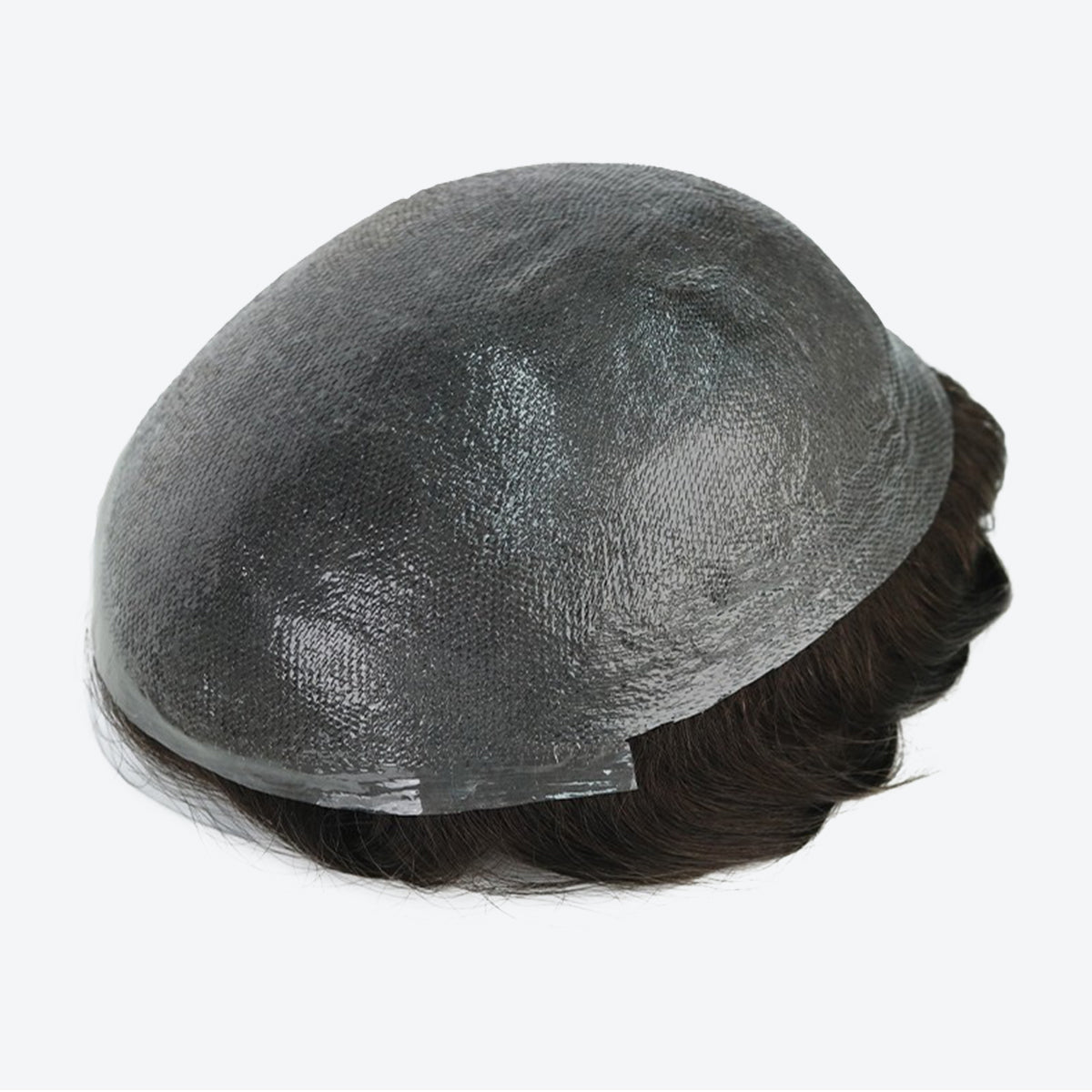
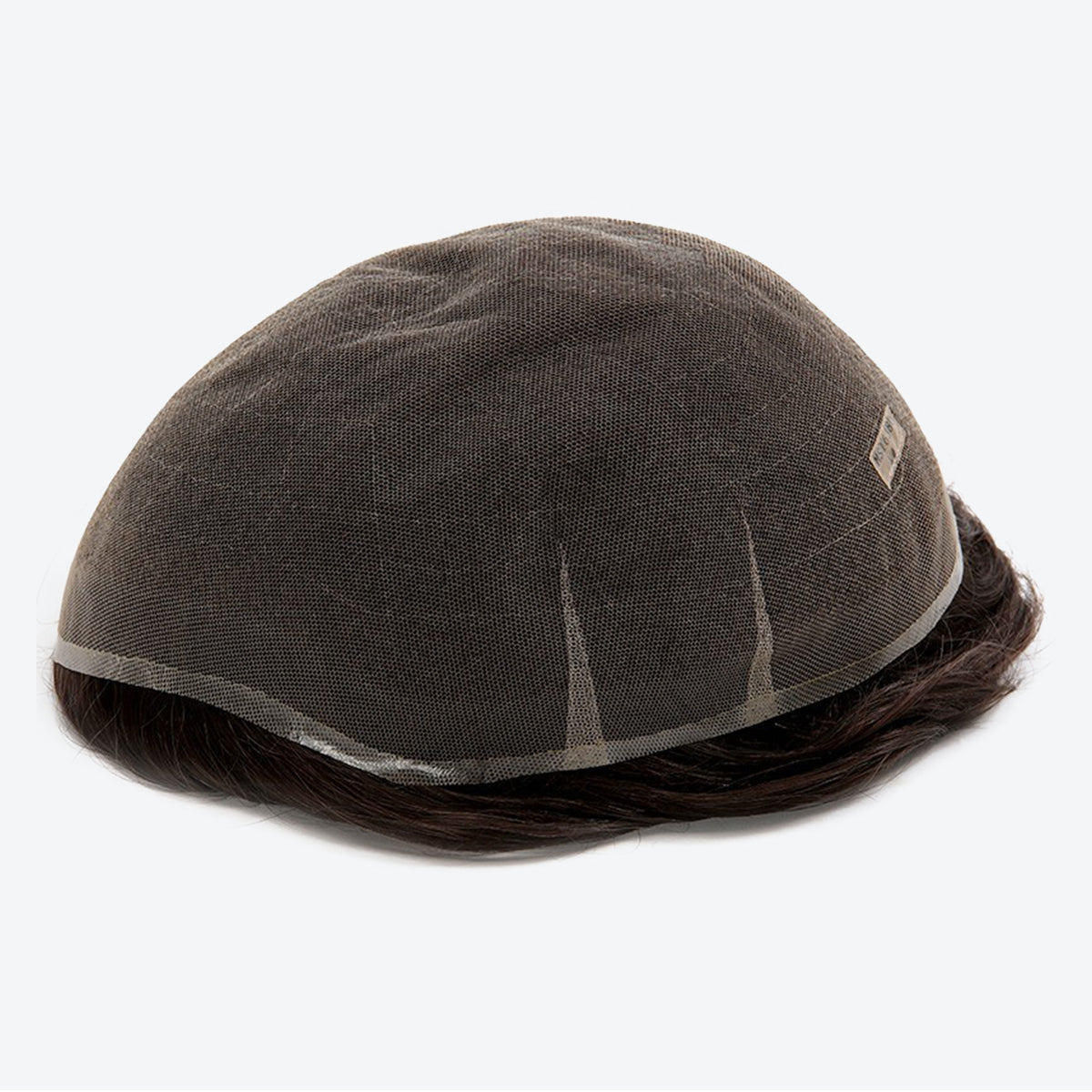
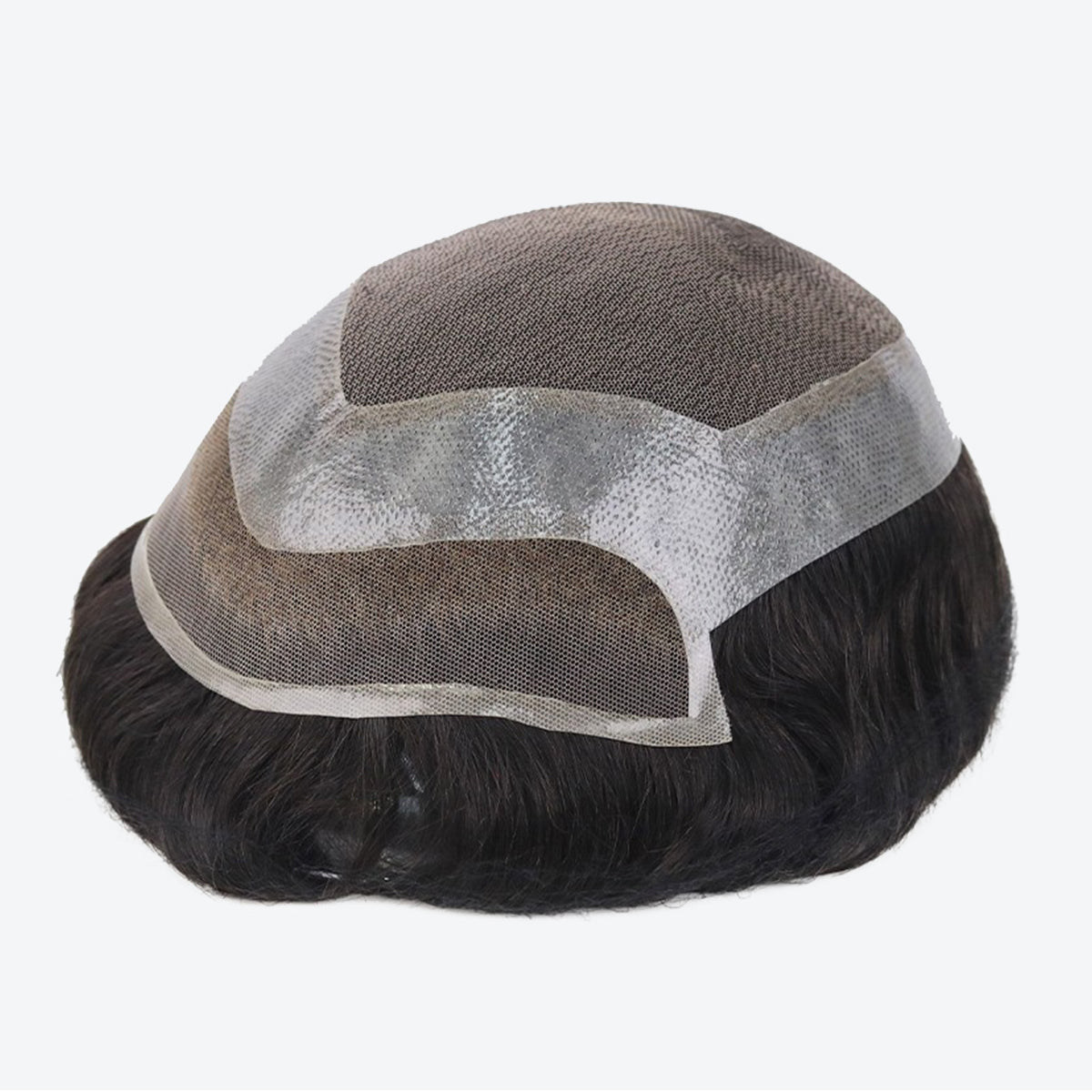

Bleached knots in a men's hair system can look softer against the scalp, while unbleached knots usually preserve more of the hair's original strength. The right choice depends on where the knots sit, whether you expose the hairline, your hair color, and how gently you handle the unit. If this feels like a lot to weigh for one small detail, that is normal. Many first-time wearers do not notice knots until they compare two lace fronts up close.
Quick Answer
Bleached knots are chemically lightened attachment points on a lace hair system. Reducing the contrast between the knot and the scalp can make an exposed front look softer and more natural. Unbleached knots keep their original color and generally avoid that extra processing so that they may offer a better strength-first choice. The trade-off is simple: bleached knots prioritize lower visibility, while unbleached knots prioritize the integrity of the tied root. Neither option is automatically right for every wearer. Base construction, hair color, density, styling, and care all affect the result. If you are not sure, start by deciding whether you regularly show the front hairline.
Quick Takeaways
- Bleached knots matter most where lace and the tied roots are visible, especially at an exposed front.
- Unbleached knots may look darker, but avoiding extra chemical processing can support a strength-first setup.
- Bleached does not mean knotless. Silk constructions may conceal knots, while some skin systems use different ventilation methods.
- Very dark shades may have product-specific bleaching limits, so check the exact variant rather than assuming every color is treated the same way.
What Are Bleached Knots in a Hair System?
On a lace base, a craftsperson ties individual hairs or small groups of hairs through the mesh. The attachment point is the knot. Its visibility changes with the knot type, number of hairs, hair color, lace color, density, and viewing distance.
This distinction matters because several root effects can look similar from above but are built differently:
- Bleached knots: tied roots are chemically lightened to reduce contrast.
- Unbleached knots: tied roots keep their original color.
- Concealed knots: a layered construction, such as a silk base, covers the tied area so it is not directly visible from above.
- Knotless ventilation: hair is inserted or looped without a conventional visible lace knot.

Bleached and knotless are not interchangeable terms. A bleached lace system still has tied knots; they are simply less visually prominent.
How Do Bleached and Unbleached Knots Compare?
The most useful comparison starts with your priority, not with the assumption that one treatment is always superior.
Use these decision criteria in order:
- Hairline exposure: decide whether your normal style shows the front or a visible part.
- Base construction: confirm that the visible area is tied lace rather than a silk-concealed or skin/poly zone.
- Exact color and variant: check whether the selected product actually includes front bleaching in that shade.
- Real viewing conditions: compare lace color, scalp contrast, density, lighting, and conversation distance, not only a macro photo.
- Handling priority: decide whether lower root contrast is worth a more delicate treated area in your routine.
| Decision factor | Bleached knots | Unbleached knots |
|---|---|---|
| Root appearance | Lower contrast can soften the dotted look on exposed lace | Darker attachment points may be easier to see at close range |
| Strength | Extra processing can make the root area more delicate | Avoids the added bleaching step and may suit a strength-first priority |
| Best placement | Front hairline or another visible lace area | Less exposed areas, fuller-density zones, or durability-led setups |
| Hairstyle fit | Useful for brushed-back, side-parted, or raised-front styles | Often easier to accept when the front is covered |
| Hair color | Availability and result vary by shade and product | More straightforward where a very dark shade limits bleaching |
| Maintenance | Calls for careful washing, brushing, removal, and conditioning around the lace | Still needs careful handling, but the knot has not received the extra lightening process |
Bleaching is only one construction variable. A finer knot or fewer hairs at an attachment point may look less prominent, while a larger, multi-hair, or reinforced knot may put more emphasis on stability. Density can also expose or soften the dotted effect. Check the actual front construction instead of treating bleached as a complete quality grade.
In our experience, most people make a clearer choice when they ask, "Where will anyone actually see the base?" If the answer is mainly the first section of the hairline, a front-focused solution may balance appearance and long-term handling better than treating every tied area the same way.
What Do Bleached Knots Look Like Before and After?
A useful bleached knots before and after comparison starts with the same unit. Before bleaching, a dark knot can resemble a small dot where the hair meets the lace. After controlled lightening, the same attachment point has less contrast, so the transition from scalp to hair can look softer. The change is easiest to judge at the front or along a visible part.
Do not compare two unrelated product photos and call the difference a knot result. Lace color, density, lighting, camera distance, hair shade, and styling can all change what you see.
Before-and-after visual standard: show the same unit, base area, angle, lighting, camera distance, and background. Include one macro view from above and one underside view. Label the images clearly as unbleached and bleached; do not use retouching that removes normal lace texture.
Which Option Fits Your Hairline and Styling Priority?
Bleached knots may fit when:
- You regularly brush the hair back or expose the front.
- Dark dots at the lace edge are a primary concern.
- You accept a more delicate root area in exchange for a softer visual transition.
- The selected product and color explicitly include bleached knots.
Unbleached knots may fit when:
- Your hairstyle covers most of the front edge.
- Preserving knot strength matters more than close-up root softness.
- Your selected shade has limited or no bleached-front availability.
- You prefer to avoid extra chemical processing on the tied roots.
If you are not sure, use a segmented starting path. For an exposed lace front, begin by comparing units that specify front-hairline bleaching. For a covered front or a strength-led routine, begin with the unbleached option and judge the appearance under your normal lighting. Take your time; there is no need to decide today.
This article is not a full lace-versus-skin base selector. It answers the knot decision on tied lace areas. The lace hair systems collection is the clearer next step when you also need to compare breathability, base layout, density, and front design.
Do Hair Color and Base Type Change the Answer?
Yes. Very dark hair creates more contrast at the root and may require more processing to lighten. That does not mean every dark shade should be processed more aggressively. Current LaVivid product pages reviewed for Helios, Mars, and Tyler state that the #1 and #1C variants do not include a bleached front hairline. Product specifications can change, so confirm the exact unit and color before ordering.
Base type matters just as much:
- Lace: the hair is tied to an open mesh, so knot visibility can be a real selection factor.
- Silk base: layers can conceal knots across the silk area; a lace-front section may still use bleached knots.
- Skin or poly: many units use V-looped or injected techniques rather than a conventional exposed lace knot. Read the individual construction details instead of looking for a bleached-knot label.


If your base is lace, use this guide to compare visible tied knots. If your base is skin or poly, start with the product's ventilation method because the same bleached-versus-unbleached decision may not apply.
If your needs involve a specific knot layout, parting area, hair color, or base construction, a custom hair system may provide the right controls. Custom does not remove the trade-off; it lets you decide where each priority matters.
Should You Bleach Knots Yourself, and Is There One Safe Processing Time?
We do not recommend treating a finished unit as a first experiment. Bleach can move through lace, lighten the visible hair, leave an uneven tone, or weaken the root if the application is too strong or left too long. A mistake at the front is difficult to reverse.
There is no single safe answer to how long it takes to bleach knots. Hair fiber, shade, previous processing, knot construction, product formula, and the treated area all change the risk. This guide therefore does not provide bleach-to-developer ratios, developer strength, processing times, or wig-closure instructions. Ask the maker or an experienced hair-system technician whether the selected area can be treated before changing a finished unit.
If this is your first hair system, choose a factory-prepared option or ask an experienced hair-system professional to inspect the base and hair first. There is a learning curve, and damaging one unit does not mean you handled every part of your routine poorly. It only means this particular process leaves little room for correction.
Your hair system routine is private and should work on your own terms. You do not need to learn a chemical process to make a sound buying decision. A clear specification and a close-up inspection are usually the calmer starting point.
How Should You Care for Bleached Knots?
Gentle handling matters more than adding a complicated routine. Follow the care instructions for the specific unit, support the base during washing and removal, and avoid pulling a brush through resistance at the root. Keep heavy conditioner away from the lace knot area unless the product instructions say otherwise.
Watch for a widening part, repeated shedding in one area, loosened knots, or lace damage. Those signs suggest the setup or handling routine needs review. Over time, a slightly more conservative knot plan may reduce avoidable replacements more effectively than chasing the least-visible root across the entire base.
FAQ
Are bleached knots completely invisible?
No. Bleaching reduces contrast, but the result still depends on lace color, density, lighting, hair shade, knot size, and viewing distance. Natural-looking is a more accurate goal than invisible in every condition.
Do bleached knots shed faster?
They can be more delicate because chemical lightening adds processing at the root. Actual shedding also depends on knot construction, brushing, washing, removal, friction, and the overall condition of the unit.
Can jet-black hair systems have bleached knots?
Availability is product-specific. Current LaVivid pages reviewed for Helios, Mars, and Tyler exclude colors #1 and #1C from their bleached-front specification. Check the selected product and color before relying on a general rule.
Are skin hair systems the same as bleached-knot systems?
Not necessarily. Many skin systems use V-looped or injected hair, so a conventional exposed lace knot may not be present. Some constructions use other techniques. The product's ventilation specification is the deciding factor.
Is bleaching the whole base better than bleaching only the front?
Not automatically. The visible front often gains the most from lower-contrast knots, while less exposed areas may benefit from a strength-first construction. Whole-base treatment should be a deliberate custom decision, not a default assumption.
Compare Lace Hair Systems
If an exposed hairline is your priority, compare the base design, density, color specification, and knot treatment together. Compare lace hair systems at your own pace.

